
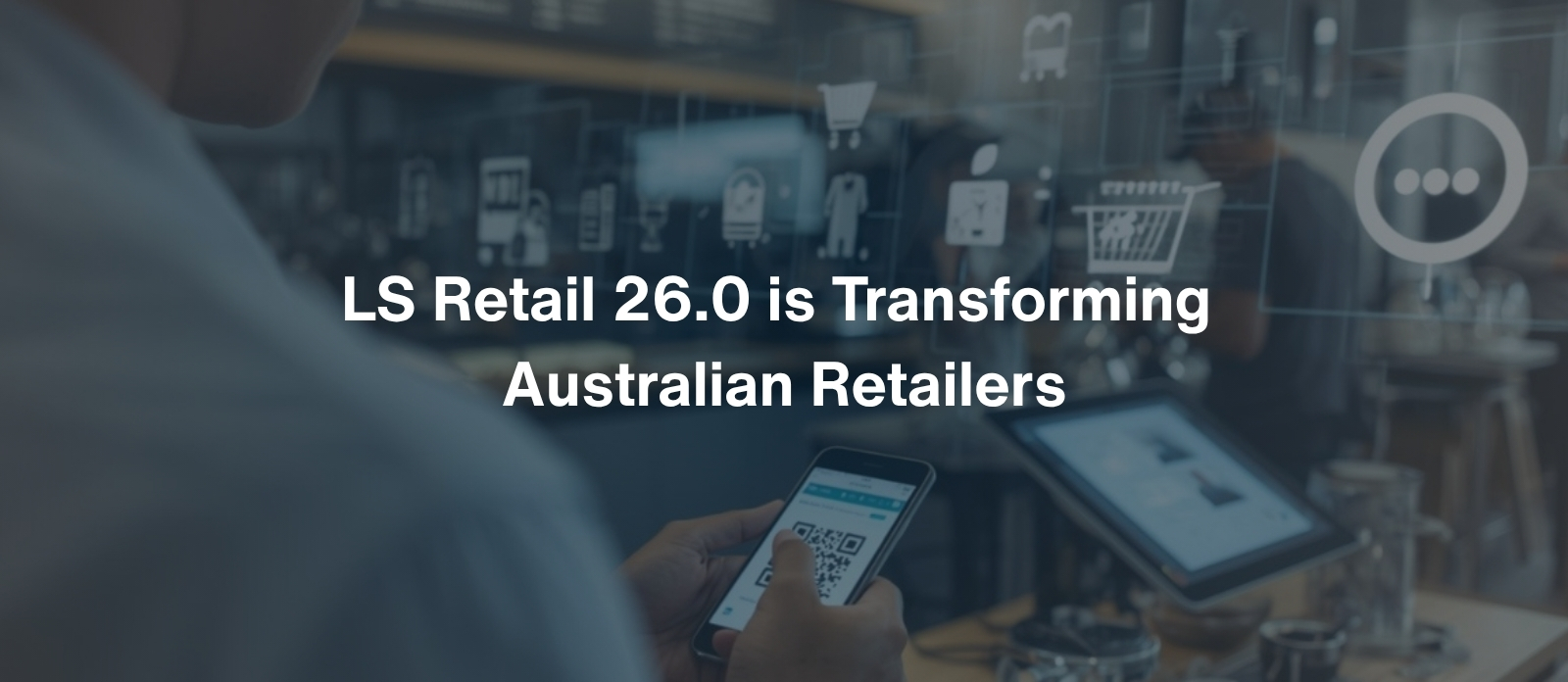
Picture this: You walk into your favorite Australian café, scan a QR code at your table, and within seconds you’re browsing a digital menu, customizing your order, and paying—all from your phone. Meanwhile, the kitchen receives your order instantly on a digital display, and your coffee is ready before you finish checking your emails. This isn’t a glimpse into the future—it’s happening right now across Australia, thanks to breakthrough retail technology like LS Retail 26.0.
If you're an Australian retailer feeling the pressure of changing customer expectations, rising operational costs, and increasing competition from global e-commerce giants, you're not alone. The statistics paint a clear picture: while 85% of Australian shoppers expect smooth, integrated experiences across all channels, only 42% of retailers have actually implemented unified commerce solutions. This massive gap represents both a challenge and an unprecedented opportunity.
Australian retail is at a crossroads. The market, valued at AUD $534.54 billion in 2024 and projected to reach AUD $725.38 billion by 2034, is experiencing a fundamental shift in customer behavior. Recent research reveals some eye-opening statistics that should have every retailer paying attention:
The Experience Economy is Here: 65% of Australian shoppers are willing to pay more for standout retail experiences, yet most retailers struggle to deliver consistency across channels. It’s no longer enough to simply have both online and physical stores—customers expect them to work together seamlessly.
Returns are Make-or-Break: While 85% of shoppers expect smooth returns experiences, only 27% of Australian retailers offer online returns initiation and tracking. This disconnect is costing retailers both immediate sales and long-term customer loyalty. LS Retail helps Australian retailers unify their operations across channels.
The Human Touch Still Matters: Despite the digital revolution, 60% of Australian shoppers believe digital channels can’t replace in-store human connections. The key isn’t choosing between digital and physical—it’s integrating them intelligently.
The financial implications are staggering. Research shows that retailers who achieve unified commerce leadership can generate an additional $19 million per billion in annual revenue. For Australia’s retail industry, this represents a potential $30 billion growth opportunity for those ready to embrace integrated commerce strategies.
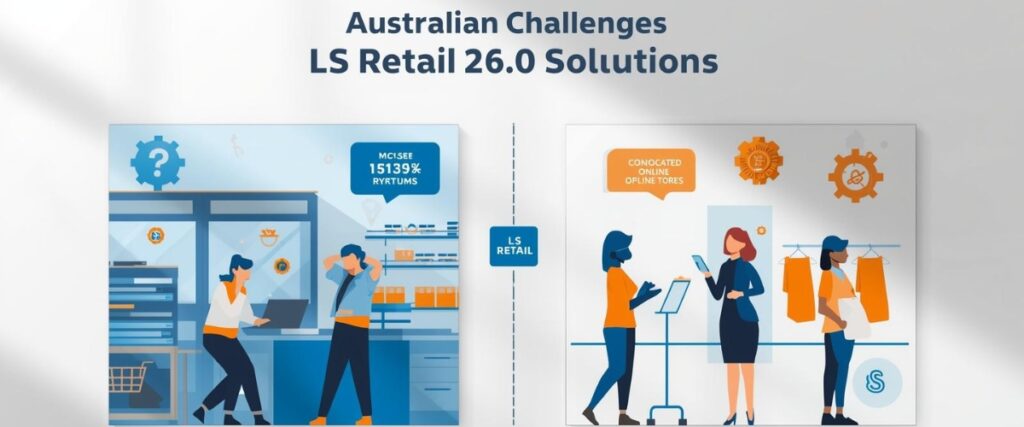
Australian Retail Market Challenges vs LS Retail 26.0 Solutions
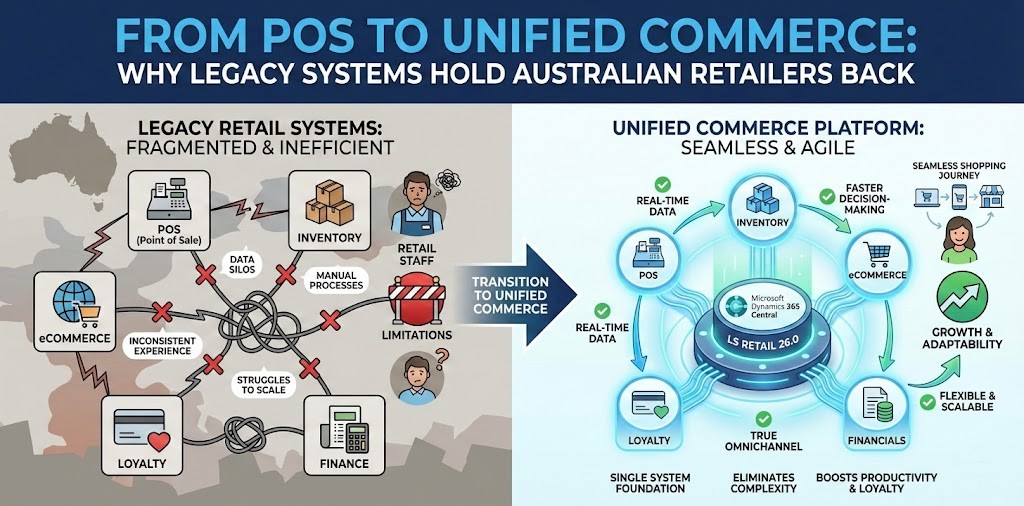
Many Australian retailers still operate with disconnected systems—one for POS, another for inventory, separate tools for eCommerce, loyalty, and finance. While each system may work individually, together they create data silos, manual processes, and inconsistent customer experiences. This fragmentation makes it difficult to deliver true omnichannel retail, where customers expect pricing, inventory, promotions, and service to be consistent across every touchpoint.
Legacy retail systems also struggle to scale. Adding new stores, launching click-and-collect, or introducing self-service often requires complex integrations and ongoing maintenance. As customer expectations rise and competition intensifies, these limitations directly impact revenue, staff productivity, and customer loyalty.
Unified commerce platforms like LS Retail 26.0 remove these barriers by bringing POS, inventory, eCommerce, loyalty, and financials into a single system built on Microsoft Dynamics 365 Business Central. This unified foundation allows Australian retailers to operate with real-time data, faster decision-making, and the flexibility needed to adapt quickly—without the cost and complexity of managing multiple disconnected platforms.
Released in April 2025, LS Retail 26.0 represents the most significant advancement in unified retail technology this year. Built on the robust foundation of Microsoft Dynamics 365 Business Central, this release directly addresses the specific challenges Australian retailers face while providing the scalability and reliability needed to compete in an increasingly demanding market.
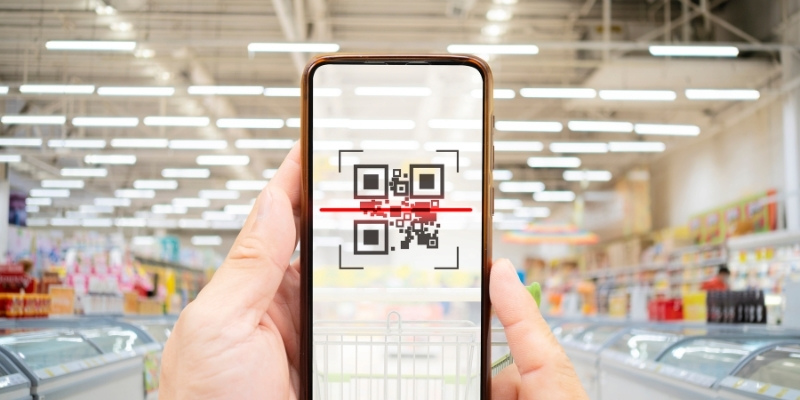
One of LS Retail 26.0’s most impressive features is its enhanced QR code group ordering system, which aligns perfectly with Australia’s strong café and restaurant culture. The system now allows multiple customers at the same table to order through separate QR codes that can merge into one bill—or split automatically if preferred.
This addresses a uniquely Australian challenge where group dining and shared meals are central to the social experience. With 36.4% of Australians already scanning QR codes weekly, and the hospitality sector projected to reach US$1.39 trillion in 2025, this feature couldn’t be more timely.
The enhanced security features are equally important. Instead of generic table QR codes, LS Retail 26.0 enables transaction-specific QR codes, significantly reducing fraud—a growing concern for Australian hospitality businesses.
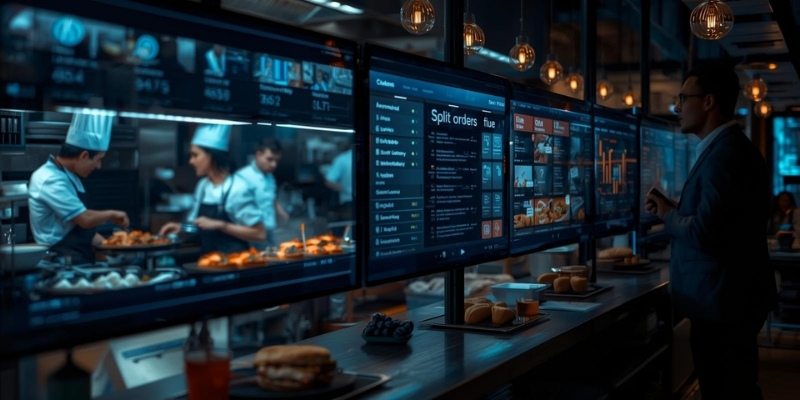
Australia’s food service sector has seen explosive growth, and LS Retail 26.0’s Kitchen Display System (KDS) enhancements are specifically designed for high-volume operations. Key improvements include:
These features are particularly valuable for Australian restaurant chains and food courts that need to maintain consistency across multiple locations while handling varying customer volumes.


LS Retail 26.0 includes specific Australian localizations that generic systems lack:

Unlike standalone retail systems, LS Retail 26.0 is built on Microsoft Dynamics 365 Business Central, providing Australian retailers with:

Australian retailers implementing LS Retail solutions consistently report impressive returns:

Australian retailers face unprecedented pressure from global e-commerce giants. Amazon, Temu, and Shein are rapidly growing market share by delivering clear value propositions: speed, range, and ultra-low prices. Traditional Australian retailers can’t compete on price alone—they need to leverage their unique advantages.
Physical stores remain crucial—over 80% of Australian retail sales still occur in physical locations. The key is connecting physical and digital experiences seamlessly, something global giants struggle to replicate with local relevance.

Recent research shows 3 out of 4 Australian shoppers have significantly changed their shopping habits in the past year. Key trends include:
LS Retail 26.0 is designed to integrate with emerging AI and automation technologies that will define retail’s future:
Australian consumers increasingly prioritize sustainability, and LS Retail 26.0 supports ESG initiatives through:
Australian retailers should begin their LS Retail 26.0 journey with a comprehensive assessment:
| Business Aspect | Traditional Multi-System | Unified Commerce LS Retail | ROI/Impact |
|---|---|---|---|
| Customer Experience | Disconnected channels, 33% customer retention rate, inconsistent pricing and promotions | Seamless omnichannel experience, 89% customer retention rate, unified customer profiles | 23% higher revenue growth, 13% increase in average order value |
| Inventory Mgmt | Manual stock reconciliation, frequent out-of-stocks, 2–3 day inventory updates | Real-time inventory across all channels, automated replenishment, centralized control | $500k potential savings from inventory optimization |
| Staff Productivity | Multiple system training, manual data entry, time-consuming reporting | Single system training, automated processes, real-time dashboards | 25–30% reduction in admin tasks |
| Data & Analytics | Siloed data, manual report compilation, delayed insights | 360-degree customer view, real-time analytics, integrated Power BI | Faster decisions, 15–25% efficiency boost |
| Implementation | Multiple vendor management, complex integrations, 6–18 months typical timeline | Single vendor, pre-built integrations, 7–12 weeks implementation | 60–70% faster time to value |
| Operational Costs | Multiple licensing fees, integration maintenance, separate support contracts | Consolidated licensing, reduced IT overhead, unified support | 31% lower fulfillment costs, reduced admin expenses |
| Scalability | Complex expansion, custom integrations for new stores, limited flexibility | Easy store rollout, standardized processes, cloud-native scaling | Seamless expansion from 1 to 35+ stores |
| Tech Integration | Point-to-point integrations, frequent breakdowns, legacy constraints | Built on Dynamics 365 BC, native Azure integration, modern APIs | 99% system uptime, future-proof tech stack |
Australian retailers consistently achieve better results when working with certified local LS Retail partners like Work Made Simple (WMS). who understand the unique challenges of the Australian market. Key partner capabilities include:
The convergence of changing consumer behavior, technological advancement, and competitive pressure has created a perfect storm in Australian retail. With only 42% of Australian retailers currently offering unified commerce, early adopters have an unprecedented opportunity to differentiate themselves and capture the $19 billion revenue opportunity that unified commerce represents.
LS Retail 26.0 isn’t just another software upgrade—it’s a strategic weapon for Australian retailers ready to bridge the omnichannel gap and compete effectively in an increasingly challenging market. The combination of breakthrough features, from enhanced QR code ordering to advanced KDS capabilities and next-generation self-service functionality, directly addresses the specific challenges Australian retailers face.
Your customers are already expecting the seamless, integrated experiences that LS Retail 26.0 enables. The longer you wait, the further behind you fall—and the harder it becomes to catch up. The Australian retail revolution is happening now. Will you be part of it?
The question isn’t whether to upgrade to unified commerce—it’s whether to lead or follow. With WMS expertise as a trusted LS Retail partner and LS Retail 26.0’s powerful capabilities, Australian retailers have their secret weapon. The only question remaining is: are you ready to use it?
LS Retail 26.0 is the latest version of LS Retail’s unified commerce platform, released in April 2025. It’s built on Microsoft Dynamics 365 Business Central and includes breakthrough features like enhanced QR code group ordering, advanced Kitchen Display Systems, and next-generation self-service capabilities specifically designed for Australian retailers.
Implementation timelines vary, but Australian success stories show impressive results. Spudshed achieved a record-breaking 7-week implementation from project kickoff to first store live. Typical implementations range from 7-12 weeks for single locations, with larger multi-store rollouts taking 3-6 months depending on complexity.
LS Retail 26.0 stands apart because it’s built on Microsoft Dynamics 365 Business Central, providing enterprise-grade financial management integrated with retail operations. It includes Australian-specific localizations like EFTPOS integration, regulatory compliance features, and robust offline capabilities designed for Australia’s varied connectivity conditions.
Australian retailers implementing LS Retail solutions typically see 31% lower fulfillment costs, 24% higher customer satisfaction, 27% improvement in cart abandonment rates, and 15-25% increase in average transaction values. For a $10 million revenue retailer, this could translate to $200,000-500,000 in additional annual profit.
LS Retail 26.0 is designed to scale from single stores to large multi-location chains. The platform grows with your business, offering the same unified commerce capabilities whether you’re running one store or 35+ locations like Cornetts Supermarkets.
The platform provides unified inventory management, real-time stock visibility across all channels, integrated customer profiles, seamless returns processing, and consistent pricing/promotions. This bridges the gap between online and offline experiences that 85% of Australian shoppers expect.
Certified local partners like WMS: Work Made Simple. provide comprehensive support including assessment, implementation, training, and ongoing maintenance. Having local expertise is crucial for understanding Australian retail regulations, payment systems, and business requirements.
Yes, LS Retail 26.0 is built on Microsoft’s platform with modern API architecture, making integration with existing systems more straightforward than traditional point-to-point integrations. The platform supports connections to e-commerce sites, payment processors, accounting systems, and third-party applications.