
Have you ever felt like your customers are one step ahead of your business? In 2025, Australian shoppers expect seamless experiences across every channel. They want to browse online, buy in-store, and return items with ease. If your systems are not connected, you’re missing out. This is not just about convenience—it is about survival in a competitive market.
Table of Contents
ToggleFor expert guidance tailored to Australian SMBs, visit Work Made Simple (WMS).
Australian retail is changing fast. Shoppers expect fast delivery, accurate inventory, and connected experiences. When retailers fall short, the impact is immediate: lost sales, declining loyalty, and rising operational costs.
According to the 2024 Unified Commerce Benchmark for Specialty Retail in Australia by Manhattan Associates and Incisiv:
of Australian shoppers expect smooth, integrated experiences across all channels.
of retailers have implemented unified commerce solutions to meet this demand.
of retailers allow customers to initiate and track returns online, highlighting a major gap in the post-purchase experience.
A modern ERP system brings all your business functions together—online sales, in-store operations, inventory, purchasing, finance, and customer data.
Platforms like Dynamics 365 Business Central for SMBs provide these capabilities through built-in finance, inventory, sales, and customer management tools.
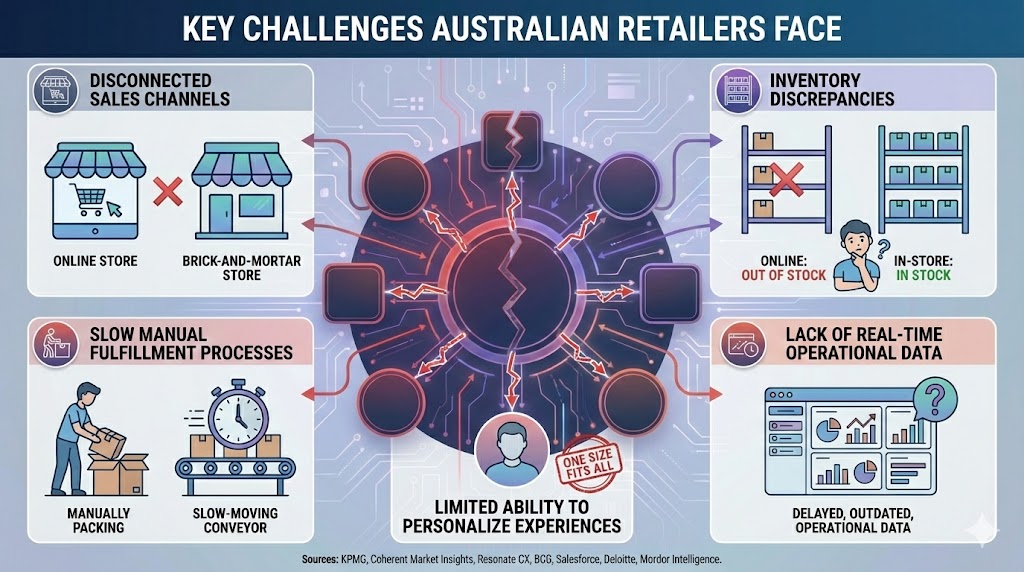
ERP connects online and physical stores, enabling seamless browsing, buying, and returns.
ERP automates order routing, processing, and status updates.
Live dashboards covering sales, profitability, inventory trends, and customer insights. Business Central 2025 reporting and analytics enhancements
ERP provides purchase history, preferences, and behavioral insights.

Leading retail ERP solutions and industry benchmarks demonstrate significant operational improvements:
Moving from manual systems to ERP often improves inventory accuracy from ~65% to over 92%, drastically reducing fulfillment errors.
Real-time visibility into working capital and automated finance workflows can improve cash flow efficiency by 15–25%. Business Central 2025 automation tools for finance
Retailers leveraging unified commerce strategies often see sales lifts of 15–30% through improved conversion rates and average transaction values.
Faster, more accurate deliveries lead to happier customers.
Personalized experiences drive repeat business.
While digital tools are essential, the in-store experience remains vital. The Current State of Omni-Channel Retail 2025 Australia Report by Resonate.cx found that 60% of Australian shoppers say digital channels can’t replace in-store human connection. ERP enhances this human element by empowering staff with immediate access to customer profiles and order insights, allowing them to provide a more personalized service.
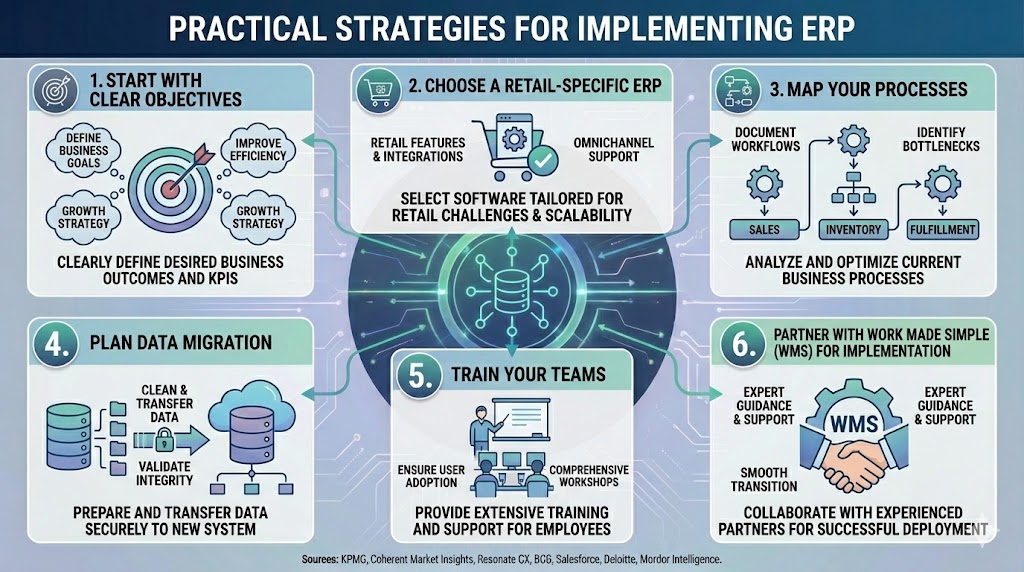
1. Start with clear objectives
3. Map your processes
4. Plan data migration
6. Train your teams
8. Partner with Work Made Simple (WMS) for implementation
| Challenge | Siloed Systems | ERP System | Benefit |
|---|---|---|---|
| Customer view | Fragmented | Unified | Higher lifetime value |
| Inventory accuracy | 60–70% | 92% | Fewer stockouts |
| Order fulfillment | Manual | Automated | Faster delivery |
| Returns | Slow | Digital | Higher retention |
| Data | Outdated | Real-time | Smarter decisions |
| Productivity | Manual | Assisted | Better service |
| Revenue | Missed | +$19M per $1B | Competitive advantage |
85% of shoppers expect omnichannel, while only 42% of retailers deliver it. This gap represents your biggest opportunity to capture market share from competitors who are slow to adapt.
ERP unifies operations, improves accuracy, enhances experiences, and unlocks profitable growth. By bridging the gap between customer expectations and operational reality, you position your retail business for long-term success.
ERP (Enterprise Resource Planning) is software that manages day-to-day business activities such as accounting, procurement, project management, and supply chain operations.
It unifies data from all sales channels (online, mobile, in-store), ensuring consistent pricing, inventory, and customer information everywhere.
Yes, by providing real-time tracking of stock levels across all locations, drastically reducing errors and stockouts.
Yes, it automates order processing, routing, and status updates, speeding up delivery times.
It centralizes customer data, allowing you to offer personalized recommendations and promotions based on purchase history.
Yes, modern cloud ERP solutions are scalable and affordable for growing small to mid-sized retailers.
Absolutely. Live dashboards provide instant visibility into sales, inventory, and financial performance.
Most modern ERPs are designed to integrate seamlessly with eCommerce platforms, POS systems, and other third-party tools.
By ensuring accurate orders, faster delivery, and smoother returns, which are key drivers of customer happiness.
Start by identifying your key pain points, setting clear objectives, and consulting with an implementation partner like Work Made Simple (WMS).