Imagine a scenario every Australian food manufacturer dreads: a recall notice. How quickly can you trace every affected batch, ingredient, and shipment down to the source? For many, the panic of chasing paperwork and piecing together spreadsheets is real. Traceability and compliance are about more than ticking boxes—they’re your business lifeline.
Table of Contents
ToggleWith global supply chains, ever-tightening regulations, and consumer trust on the line, traceability now separates industry leaders from the rest. This is where a robust ERP system earns its stripes—turning compliance from a burden into a strategic advantage.
For expert guidance tailored to Australian SMBs, visit Work Made Simple (WMS).

Devinder Sareen is a Microsoft Dynamics 365 Business Central and LS Retail partner with 20+ years of ERP implementation experience across Australian retail, distribution and manufacturing.
Australian food and beverage manufacturers operate under some of the world’s most stringent traceability frameworks. Your ERP must be capable of meeting all of the following — not just some:
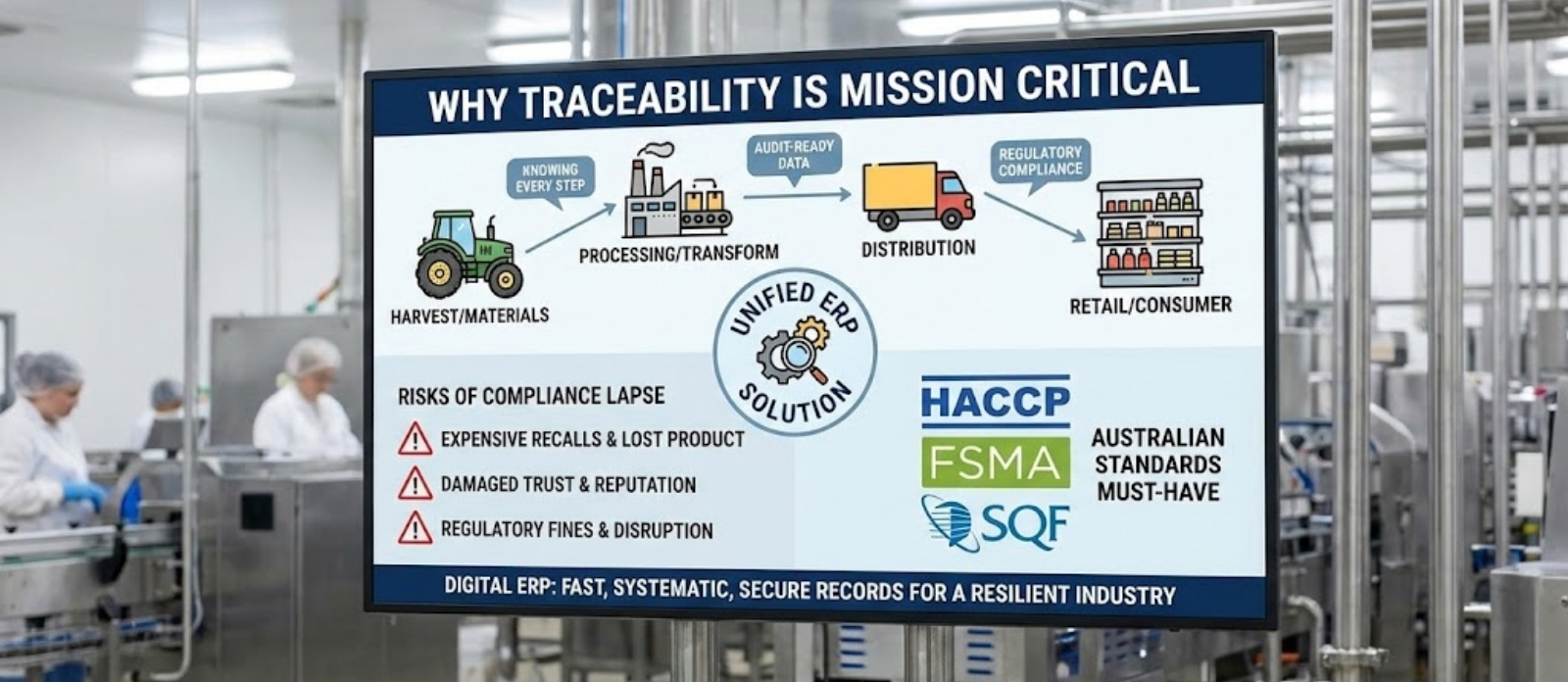
Traceability means knowing, at every step, exactly where your materials come from, how they’re transformed, and where finished products go. For food and beverage manufacturers, it’s a regulatory must-have under Australia’s HACCP, FSMA, and SQF standards.
A single compliance lapse can mean:
A digital ERP system makes finding answers fast, systematic, and audit-ready—no more guesswork when it matters most.


Think of ERP (Enterprise Resource Planning) as your digital backbone. Instead of scattered files and siloed systems, ERP centralizes every piece of product data: ingredient lots, batch numbers, supplier details, warehouse locations, QA checklists, and shipping records.
Many Australian manufacturers choose Dynamics 365 Business Central ERP for SMBs as the foundation for this level of centralized control and compliance.
Benefits of ERP-enabled traceability:
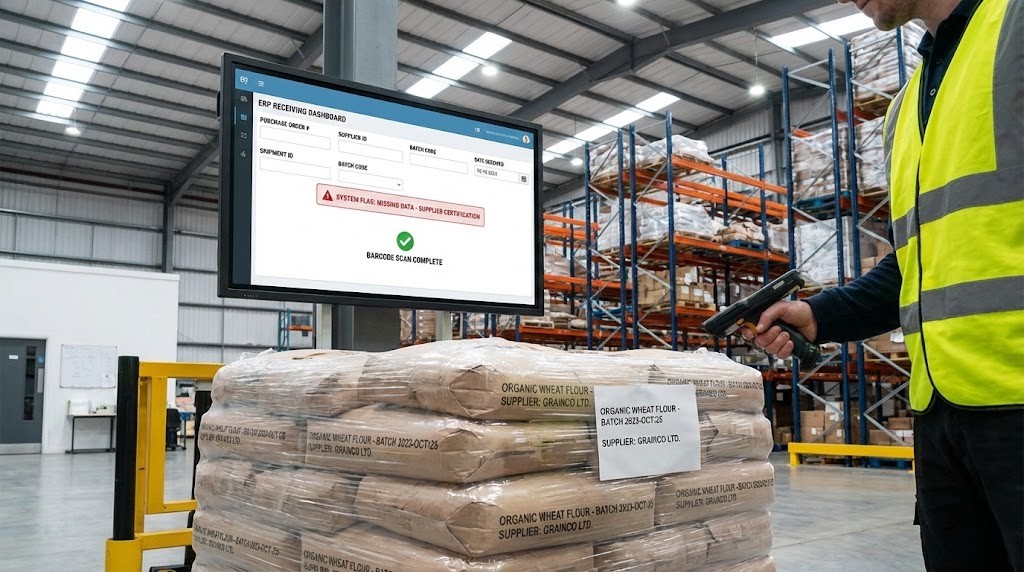
ERP systems are designed to collect, connect, and protect massive amounts of data at each touchpoint. Modern solutions log supplier details, purchase orders, incoming shipment IDs, product batches, and date codes as soon as materials arrive.
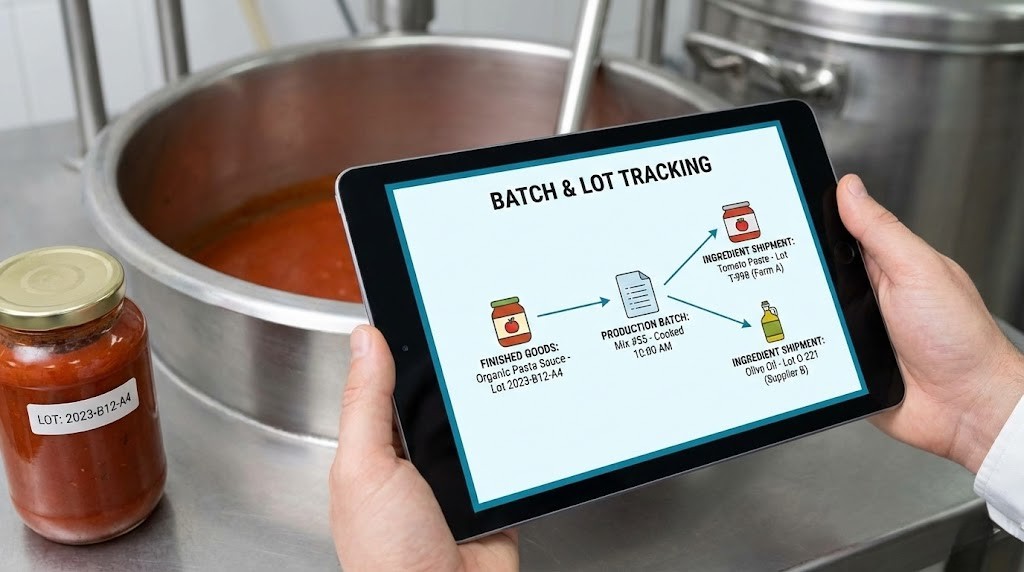
Each batch is assigned a unique lot or serial number, letting you trace outputs all the way back to the original shipment or farm.

No more paper checklists. Each stage—storage, production, packing, shipping—requires digital sign-offs tied to each item or lot.
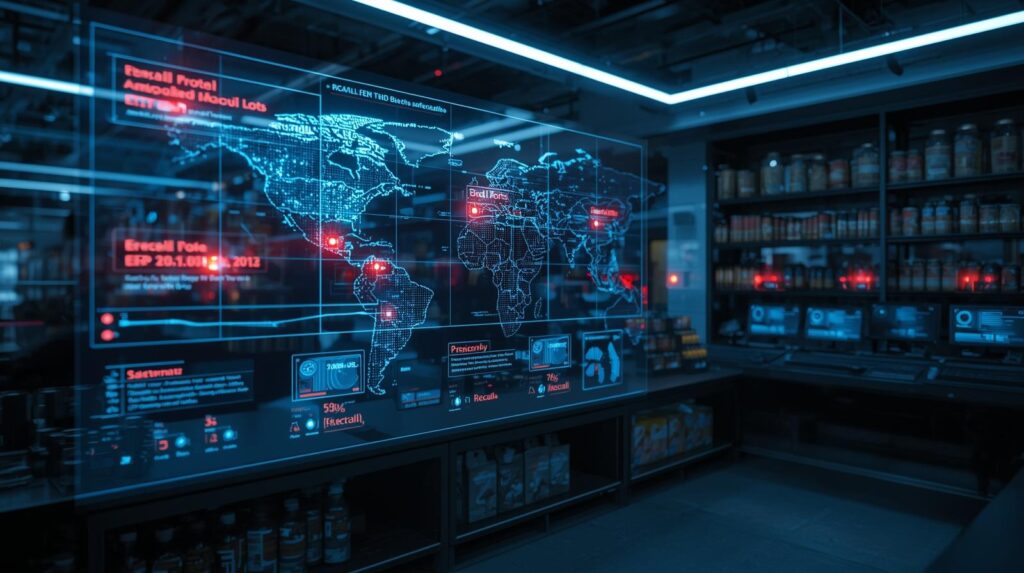
If a food safety alert or customer complaint hits, ERP traceability lets you instantly search and isolate every batch that used a specific ingredient, supplier, or machine run.

ERP links inventory, production, and distribution data, so you can anticipate shortages, expiry risks, or bottlenecks before they become problems.
Think of ERP-enabled traceability as a “Google Maps” for your products. You can instantly see where every item is, where it came from, where it’s headed, and even view its historical journey—all in one glance. Imagine trying to navigate Sydney without GPS—that’s running traceability on spreadsheets!
This shift toward real-time visibility reflects broader 2025 cloud ERP trends in Australia, where manufacturers are moving away from spreadsheets to intelligent, scalable systems.
Australian food safety regulations (HACCP, FSMA, SQF) require rapid, reliable traceability, plus audit-ready records for all manufacturing steps.
ERP helps your business:


With ERP traceability:
ERP brings together supplier approvals, certifications (organic, allergen-free), and transport records—so you know and can prove where everything comes from and goes.
Food manufacturers comparing platforms can explore the best ERP for small business in Australia (2025 comparison guide) to evaluate compliance-ready options.
| Challenge / Old Method | ERP-Enabled Solution | Benefit for Food Makers |
|---|---|---|
| Paper logs, spreadsheets | Digital records, live dashboards | Reliable tracking, audit-ready |
| Slow, partial recalls | Immediate, automated backward & forward tracking | Fast risk management, less loss |
| Siloed QA and production records | Unified digital QA logs, sign-offs | Fewer errors, stronger defense |
| Uncertain supplier/document trails | Integrated vendor and certification data | Trusted supply chains |
| High manual compliance workload | Automated reporting, workflow alerts | Lower cost, more consistency |
Traceability and compliance don’t have to be a headache. With the right ERP solution, Australian food and beverage manufacturers can turn regulatory requirements into a business asset—reducing risk, winning customer trust, and smoothing the path to growth.
Ready to take control of traceability and compliance? Talk to the local ERP experts at Work Made Simple (WMS)—and see how digital transformation can future-proof your business, batch by batch.
Strict standards (like HACCP, FSMA) and evolving consumer expectations mean that being able to trace each ingredient and batch is essential for compliance, consumer safety, and brand trust.
Yes, modern ERP systems automate allergen tracking, manage expiry dates, and enable targeted, fast product recall management for full risk control.
ERP unifies supplier, ingredient, and QA data in a searchable digital record—making audits faster and building supply chain transparency.
Yes! Many ERP platforms support international code requirements, document translation, and multi-market QA compliance.
Start by mapping your current traceability process, then work with an experienced ERP provider like Work Made Simple (WMS) to tailor a solution for your business and regulatory needs.