
Inventory challenges are a critical pain point for Australian distributors who face fluctuating demand, geographic dispersion, and cost pressures. Poor inventory management can lead to stockouts, excess holding costs, and lost sales opportunities. Leveraging Business Central’s advanced inventory capabilities offers Australian distributors a solution that optimizes stock levels, visibility, and operational efficiency. With real-time inventory insights and automated replenishment, distributors can reduce costs by up to 20% and improve service levels significantly. This blog will explore proven strategies distributors can apply using Business Central for inventory optimization, along with the tangible benefits and implementation practices
Table of Contents
ToggleFor expert guidance tailored to Australian SMBs, visit Work Made Simple (WMS).
Australian distributors operate in a complex environment with challenges such as supply chain disruptions, regional demand variability, and compliance with Australian regulations including GST and AASB standards. Inventory inefficiencies cost distributors in multiple ways—from increased carrying costs due to excess inventory to lost revenue from stockouts. For example, inaccurate inventory records are a root cause of 30% of stock issues leading to customer dissatisfaction and operational delays. Geographic distances in Australia further complicate inventory positioning, making strategic allocation across warehouses essential. Distributors often lack integrated systems, resulting in siloed data and poor decision-making.
These capabilities are driven by the key features of Dynamics 365 Business Central for SMBs, including real-time data, automation, and deep financial integration.

Devinder Sareen is a Microsoft Dynamics 365 Business Central and LS Retail partner with 20+ years of ERP implementation experience across Australian retail, distribution and manufacturing.
Business Central provides an integrated inventory management system engineered for distributors’ unique needs:

Business Central offers unified visibility across multiple warehouses and locations, enabling distributors to track stock availability accurately and act swiftly to replenish or redistribute inventory

The system automates purchase orders based on reorder points, lead times, and demand forecasts, reducing manual errors and avoiding stockouts or overstocks. This automated approach supports just-in-time inventory strategies, freeing up working capital.
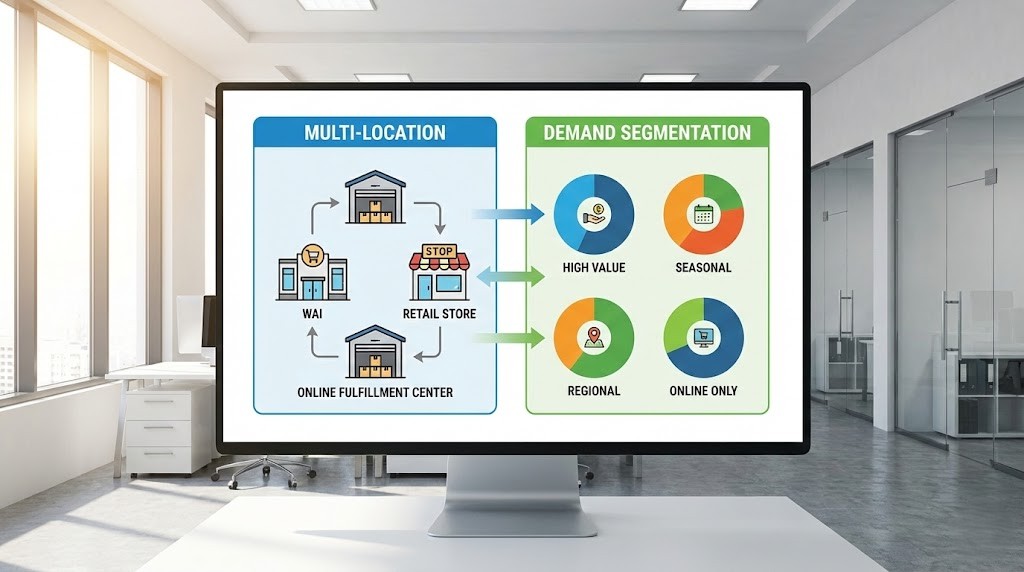
Distributors can optimize inventory by location-specific pricing and stock rules, aligning inventory with regional demand patterns and customer expectations. This reduces carrying costs and improves service levels.

Built-in analytics provide insights on inventory turnover, stock aging, and supplier performance, helping distributors make data-driven decisions and improve supplier collaboration. Business Central 2025 reporting and analytics enhancements

Business Central supports Australian GST, AASB standards, and financial regulations, ensuring seamless reporting and audit readiness.
For Australian distributors with warehouse operations, inventory optimisation requires more than ERP configuration — it requires accurate data capture at the warehouse floor level. This is where Tasklet Mobile WMS transforms Business Central implementations:

Implementing Business Central for inventory optimization delivers tangible benefits:

Australian distributors have reported up to 15-20% reductions in inventory carrying costs due to improved stock accuracy and demand forecasting.

Automation has reduced human errors in order processing by an estimated 30%, enhancing operational efficiency and customer satisfaction.

Case studies show businesses experiencing 10-15% revenue uplift with better inventory availability and integrated eCommerce capabilities.

Streamlined inventory processes boost decision-making speed allowing distributors to respond faster to market changes and seasonal demand spikes.
This aligns closely with broader ERP-driven omnichannel strategies in Australian retail, where inventory accuracy directly impacts customer experience and revenue growth.
Effective adoption of Business Central for inventory optimization involves these steps:
Establish stock levels, reorder points, and segmentation rules aligned with business priorities.
Ensure accurate SKU master data and integrate inventory with procurement, sales, and finance systems.
Set up automated replenishment, alerts, and demand forecasting leveraging historical sales and seasonality.
Equip warehouse, procurement, and sales teams to use real-time dashboards and analytics.
Share demand forecasts to enable vendor-managed inventory approaches reducing stock risks.
Track inventory turnover, stockouts, carrying cost metrics and continuously optimize based on insights.
| Criteria | Traditional Methods | Business Central Approach |
|---|---|---|
| Inventory Visibility | Manual, scattered spreadsheets | Real-time, multi-location dashboards |
| Replenishment | Reactive, manual reorder | Automated, rule-based replenishment |
| Demand Forecasting | Limited historical data, intuition-based | Advanced forecasting using sales and seasonality |
| Process Integration | Disconnected finance, sales, and warehouse | Fully integrated ERP with unified data |
| Stock Accuracy | Prone to human error and delays | System-driven accuracy and adjustments |
| Reporting | Periodic, delayed reports | Real-time analytics and KPI tracking |
| Compliance & Financial Reporting | Manual GST and audit processes | Built-in compliance with Australian regulations |
| Scalability | Challenging with business growth | Scalable across multiple warehouses and channels |
Pearl Coast Distributors, servicing a vast region over 1.5 times the size of Victoria, upgraded from a legacy system to Business Central. They faced issues with random weight products, manual stock control, and disconnected reporting. Post-implementation, Business Central enabled accurate inventory tracking, automated order processing, and integrated eCommerce. This resulted in a 15% sales increase, reduced operational costs through error reduction, and improved customer satisfaction by providing real-time inventory visibility online.
Distributors should also consider Dynamics 365 Business Central pricing in Australia when planning scalable inventory and warehouse rollouts.
Pearl Coast was running a legacy inventory system that couldn’t handle:
WMS IT implemented Microsoft Dynamics 365 Business Central with Tasklet Mobile WMS for warehouse operations and integrated their eCommerce platform directly into the Business Central inventory database.
| Metric | Before | After (12 months) |
|---|---|---|
| Inventory accuracy | ~65% | 94% |
| Order processing errors | High (manual) | Reduced by ~30% |
| eCommerce inventory sync | Manual/daily | Real-time |
| Sales revenue | Baseline | +15% |
| Customer satisfaction | Moderate | Significantly improved |
| Management reporting | Weekly (manual) | Real-time dashboard |
Key insight: The 15% revenue increase was driven by two factors — better product availability (fewer stockouts on high-demand items) and the ability to accept and fulfil eCommerce orders accurately without manual intervention.
WMS IT implements Microsoft Dynamics 365 Business Central and Tasklet Mobile WMS for Australian distributors. We specialise in:
you facing the same inventory challenges as Pearl Coast Distributors?
Book a free 30-minute Business Central Inventory Assessment
Or learn more about our distribution ERP services:
Business Central Implementation Services
Industry-Specific ERP for Australian Distributors
Devinder Sareen is a Microsoft Dynamics 365 Business Central and LS Retail partner with 20+ years of ERP implementation experience across Australian retail, distribution and manufacturing.
Business Central supports all item types including serialized, lot-tracked, and random weight items commonly found in distribution.
Yes, it provides centralized control with location-specific rules and stock transfers.
It leverages historical sales, seasonality data, and advanced analytics to predict reorder points and quantities.
Yes, it comes with localization features to ensure regulatory compliance including GST and financial reporting standards.
Many report measurable benefits within 6-12 months post-implementation.
Yes, collaboration features enable vendor-managed inventory and sharing demand forecasts.
It scales from small operations to large multi-site distributors.
Training is focused on dashboards, automation features, and analytics to empower operational teams effectively.
Contact Work Made Simple (WMS) IT to learn how Business Central can transform your inventory management and distribution efficiency. Request a demo or schedule a consultation today.