
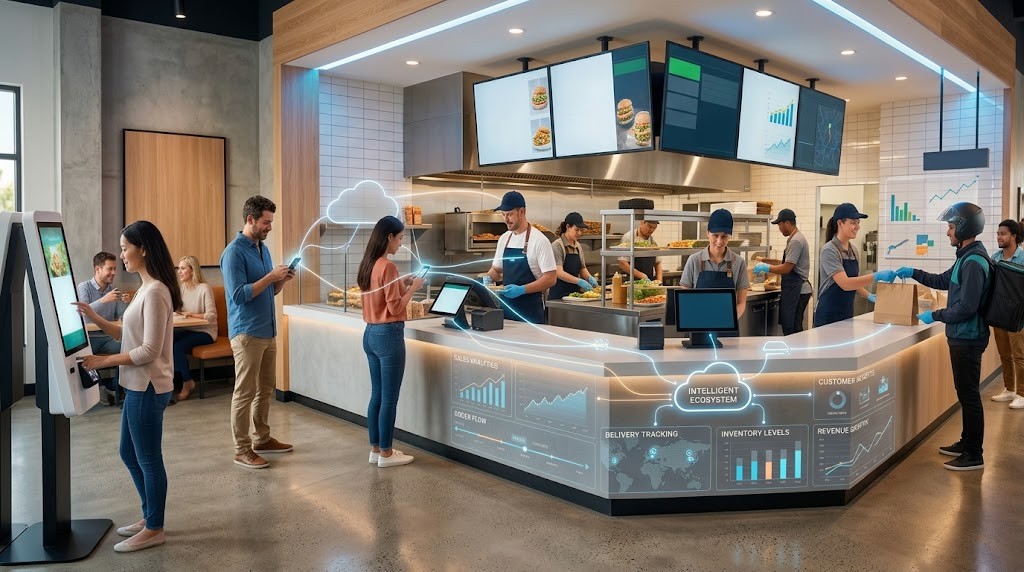
It’s 12:15pm on a Tuesday, and your busiest store just hit a wall. The kitchen is slammed, the phone won’t stop ringing, and there’s a line out the door. Somewhere in that chaos, an order gets mixed up, a regular customer gives up and leaves, and a delivery driver waits ten minutes past pickup time.
If you run a quick service restaurant (QSR) in Australia, this scene probably feels familiar. It’s not a bad day — it’s a normal Tuesday. And it’s costing you more than you think.
Order friction isn’t just an operational headache. It’s a revenue leak.
Consider the numbers:
For a single-store operator, that might mean a few lost sales a week. For a multi-site QSR group, it compounds fast: lost revenue, inconsistent customer experience across locations, and head office flying blind because sales, stock, and loyalty data live in five different systems that don’t talk to each other.
The risk isn’t just missed orders today. It’s falling behind competitors who’ve already made ordering effortless — and losing the customer data that should be helping you make smarter decisions tomorrow.

This is exactly the gap WMS (Work Made Simple) helps QSRs close. We implement LS Retail on Microsoft Dynamics 365 Business Central — a single platform that connects your point of sale, online and app ordering, kitchen operations, inventory, and head-office reporting.
Instead of digital ordering sitting off to the side as a bolt-on app, it becomes part of one connected system. Orders flow straight into the kitchen, stock is deducted in real time, and every transaction — dine-in, drive-thru, click-and-collect, or delivery — lands in the same dataset your finance and operations teams already trust.
Think of it like this: most QSRs are running ordering, POS, loyalty, and inventory as separate rooms in a house with no doors between them. Business Central and LS Retail knock those walls down and build hallways — so information (and revenue) can move freely.
Before looking at solutions, it helps to name the challenges clearly:
| Challenge | What It Looks Like Day-to-Day | Business Impact |
|---|---|---|
| Order accuracy | Mis-heard phone orders, miskeyed POS entries | Remakes, refunds, unhappy customers |
| Peak-hour bottlenecks | Long queues, kitchen overload at lunch/dinner rush | Lost sales, staff burnout |
| Disconnected channels | Separate systems for in-store, app, and delivery orders | Inventory errors, reporting headaches |
| Limited customer insight | No unified view of repeat customers or spend | Missed loyalty and upsell opportunities |
| Multi-site complexity | Each store runs slightly differently | Inconsistent brand experience, hard-to-scale operations |
None of these are signs of a poorly run business — they’re the natural result of growing faster than your systems can support. The good news: each one has a practical fix.
1. Order accuracy → Direct-to-kitchen digital orders When customers order via app, kiosk, or website, the order goes straight to the kitchen display — no re-typing, no mishearing. Fewer errors mean fewer remakes and less wasted food cost.
2. Peak-hour bottlenecks → Smoothed-out demand Digital ordering lets customers order ahead and schedule pickup or delivery times, spreading demand across the rush instead of piling it all into a 15-minute window. Staff can prepare orders in sequence instead of firefighting.
3. Disconnected channels → One system, one source of truth Every channel — in-store POS, mobile app, third-party delivery, click-and-collect — feeds into the same Business Central backend. Stock levels update automatically, so you’re not accidentally selling items you’ve run out of, and finance isn’t reconciling five separate reports at month-end.
4. Limited customer insight → Built-in loyalty and CRM data LS Retail captures purchase history and loyalty activity in one place. That means you can spot your best customers, run targeted promotions, and measure what’s actually driving repeat visits — not guess.
5. Multi-site complexity → Centralised control, local flexibility Head office gets real-time visibility across every location — sales, stock, staff performance — while each store can still run its own menu variations, pricing, or promotions where needed. You get consistency without losing local flexibility.
If you’re considering a move to connected digital ordering, a few practical steps make the transition smoother:
Digital ordering isn’t about replacing your kitchen team or your in-store experience — it’s about giving both room to do their best work. When orders are accurate, channels are connected, and data flows automatically, your team spends less time firefighting and more time serving customers well.
For Australian QSRs looking to grow — whether that’s one store aiming for smoother rushes, or a multi-site group chasing consistency across locations — connected digital ordering through LS Retail and Business Central is a practical, proven way to get there.
Ready to see what it could look like for your business? Contact WMS (Work Made Simple) to request a demo and explore how connected digital ordering can help your QSR grow revenue, one order at a time.
Digital ordering refers to customers placing orders through apps, websites, kiosks, or online platforms rather than solely at the counter or by phone, with orders feeding directly into store systems.
It reduces order errors, speeds up service during peak hours, enables upselling through app prompts, and captures customer data that supports targeted loyalty offers — all of which contribute to higher average order value and repeat visits.
LS Retail is a retail and hospitality management solution built on Microsoft Dynamics 365 Business Central. It unifies POS, inventory, loyalty, and digital ordering channels into a single connected system.
Not necessarily, but running digital ordering on the same platform as your POS, inventory, and finance systems (like Business Central with LS Retail) avoids data silos and manual reconciliation.
Yes. Even single-site operators benefit from reduced order errors and better customer insight, and the system can scale with you if you expand to multiple locations later.
Timelines vary by business complexity, but a focused rollout at a single location can often be achieved in a matter of weeks, with multi-site rollouts phased over a longer period.
Yes, integrations with delivery platforms are common, allowing orders from multiple channels to flow into one central system.
It typically doesn’t reduce headcount so much as reduce wasted time — staff spend less time on order-taking errors and more time on food quality and customer service.
By capturing order history and preferences, businesses can run targeted loyalty programs and promotions, encouraging repeat visits.
You can contact WMS (Work Made Simple) to request a demo and discuss how LS Retail and Business Central can be tailored to your QSR’s needs.