
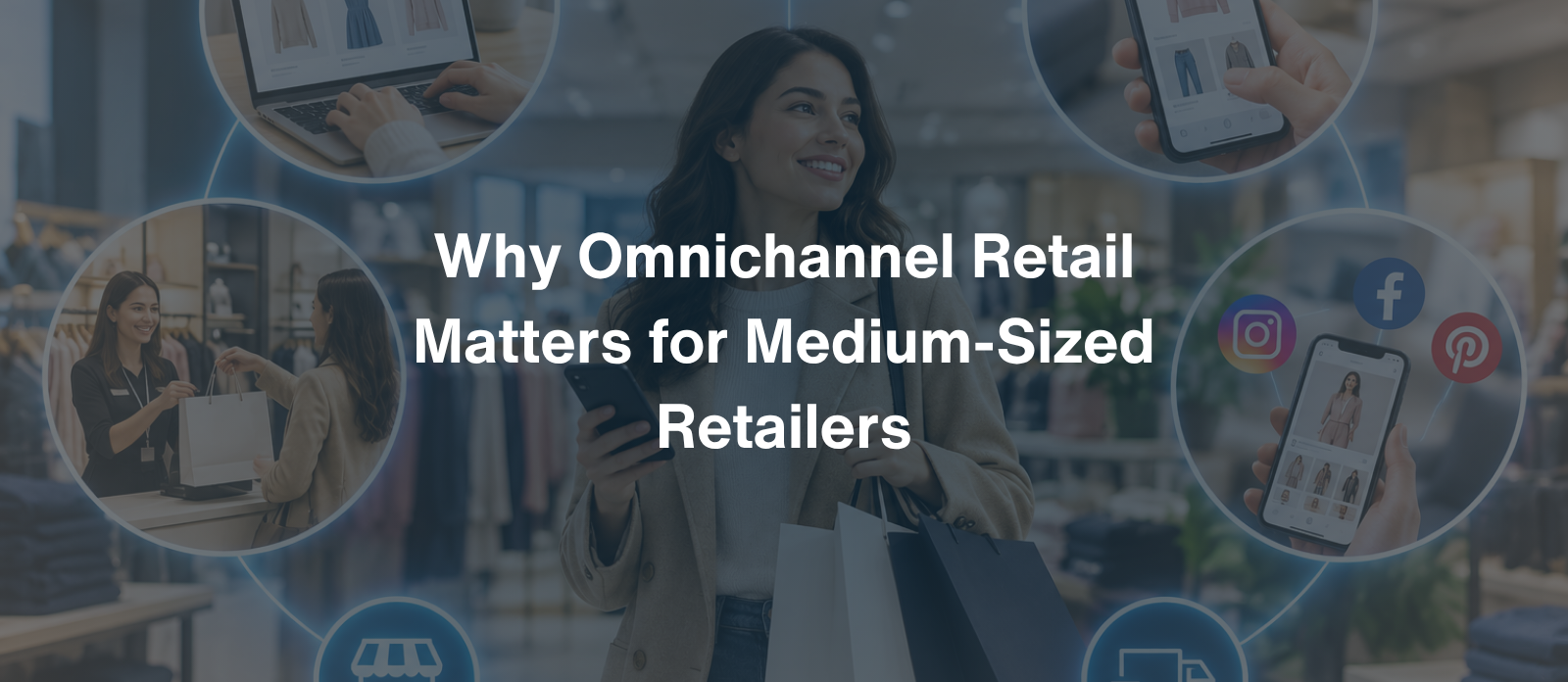
Customers no longer think in channels. They expect to browse online, buy in-store, collect from store, return anywhere, and receive a consistent experience every time.
For medium-sized retailers, an omnichannel retail solution is not just a technology upgrade. It is a growth, customer experience and operational efficiency strategy, and the data backs that up: retailers with strong omnichannel engagement retain an average of 89% of customers, compared with just 33% for retailers that engage through a single channel (Capital One Shopping Research, 2026 Omnichannel Statistics).
Today’s shoppers want to move fluidly between browsing online, buying in-store, clicking and collecting, and returning through whichever channel is most convenient. Nearly three-quarters of shoppers (73%) now engage across multiple channels during a single buying journey, using an average of six touchpoints before they purchase, up from just two touchpoints fifteen years ago (RevenueMemo, Omnichannel Marketing Statistics 2026).
For a mid-sized retailer, that means the in-store experience, the website and the mobile app all need to reflect the same stock, pricing and promotions in real time. Retailers offering buy-online-pick-up-in-store (BOPIS) see purchase likelihood increase by 19.8%, and 47% of BOPIS shoppers make an additional in-store purchase while collecting their order (Marketing LTB, Omnichannel Statistics for 2026).

A sale shouldn’t be lost just because stock isn’t available at one specific location. Ship-from-store, endless-aisle capability and real-time stock visibility mean a customer standing in a store that’s out of their size or colour can still complete the purchase instead of walking out empty-handed.
The revenue case is well documented: omnichannel customers spend 16% more per order than single-channel shoppers and carry up to 30% higher lifetime value (Ringly.io, 50 Omnichannel Retail Statistics for 2026). Converting a single-channel customer into an omnichannel one increases both their shopping frequency and basket size by roughly 8%, and big-box retailers see a 30.6% increase in average online order size after opening a new physical store nearby (Capital One Shopping Research, 2026 Omnichannel Statistics).
Connecting inventory across stores, warehouses and online channels is where the operational payoff shows up. When every channel draws from the same real-time stock picture, retailers see fewer stockouts, less excess inventory tying up cash, and more accurate replenishment.
Unified commerce also cuts friction earlier in the funnel: retailers running an integrated omnichannel solution report an 18% lower cart abandonment rate and a 31% reduction in first-resolution times when customers do need support, compared with retailers still operating in siloed channels (Marketing LTB; SHNO.co, Omnichannel Marketing Statistics for 2026).
A single customer profile across all channels, tying together loyalty, purchase history and personalised promotions, is what turns a one-time buyer into a repeat one. Personalisation delivers measurable results: companies that focus on it see an average 46% boost in customer spending (Envive, Omnichannel Retail Engagement Statistics for eCommerce 2026), and existing customers already spend 67% more than new ones, making retention through a unified profile one of the highest-leverage moves a mid-sized retailer can make (Marketing LTB).
Connecting POS, ecommerce, inventory, fulfilment and reporting into one platform is what lets a growing mid-sized retailer add stores or channels without multiplying manual work. Automated processes and shared data mean better business insights and faster, more controlled growth, rather than each new channel becoming its own operational silo.
The market is moving fast enough that standing still isn’t neutral, it’s a competitive disadvantage: the global omnichannel retailing market is projected to grow from roughly USD 10-11 billion in 2025-2026 to over USD 25-29 billion by the early 2030s, a compound annual growth rate of around 14% (RevenueMemo, Omnichannel Marketing Statistics 2026).
Omnichannel retail helps medium-sized retailers increase sales, improve inventory performance and deliver a seamless customer experience, and the retention, revenue and cost data all point the same direction. For mid-sized retailers weighing whether this is worth the investment, the more pressing question is how much longer a single-channel or loosely connected multichannel setup can keep pace with where shopper expectations, and competitors, already are.
Talk to WMS about unifying your POS, ecommerce and inventory on LS Central and Business Central.
An omnichannel retail solution connects POS, ecommerce, inventory, customer data and fulfilment so customers can move seamlessly between online and in-store shopping while the retailer maintains consistent pricing, promotions and stock visibility.
It allows customers to browse online, buy in-store, use click and collect, and return purchases through convenient channels. A unified system keeps customer, product and order information consistent across every touchpoint.
Yes. Real-time inventory visibility across stores, warehouses and online channels helps retailers identify available stock and fulfil orders from the most suitable location. This can reduce missed sales caused by products appearing unavailable in one location.
By connecting customer profiles, loyalty activity, purchase history and personalised promotions, retailers can create more relevant shopping experiences. Omnichannel customers also tend to have higher purchase frequency, basket sizes and lifetime value than single-channel customers.
An omnichannel retail solution helps medium-sized retailers scale stores and sales channels without creating additional operational silos. Connecting POS, ecommerce, inventory and reporting provides shared data, automation and better visibility as the business grows.